
Marion Township Resident Lookup Records
Official sources in Marion Township serve different purposes. The Marion County Auditor Property Search can connect a listed owner to a parcel, situs address, legal description, tax district, sales facts, and a tax-mailing clue. The Ohio voter tools can confirm only the public registration fields. Courts, vital offices, probate, and local-history holdings answer narrower questions. None is a complete list of everyone at an address, and an older entry may be true for its date but not for today.
| Record | What it can confirm | Custodian | Access route |
|---|---|---|---|
| Property roll | Listed owner, parcel, situs, tax district, sale context | Marion County Auditor | Free portal, phone, or office visit |
| Voter record | Permitted elector, address, precinct, and activity fields | Marion County Board of Elections | Official lookup, reports, or a focused request |
| Court file | Named party, case number, division, and docket context | Clerk, Probate, or Municipal Court | eAccess, CaseLook, clerk, or public terminal |
| Vital or probate record | Family event or estate relationship when public | Public Health or Probate Court | Counter, approved order channel, court, library, or archive |
| Historical shelf | Dated address, obituary, school, or family context | Marion Public Library | Local History Room paper and microfilm holdings |
For a current ownership question, begin with the Auditor. For a registration or polling question, use the Board of Elections. If a name must be distinguished from another person with the same name, add a dated court, probate, or historical record. The Marion Public Library Local History Room is the practical fallback when a question is historical rather than current.
Matching a Marion Township Resident
A sound resident lookup starts by writing down the full supplied name, middle initial or former surname if known, an approximate age or time window, and one non-sensitive place detail. Search each source for that limited question. The Auditor accepts Owner Name in a Last First format, along with parcel and structured address options. Its Township and tax-district filters matter because a Marion postal label can cross Township and City lines. A mailing address is correspondence evidence, not proof that an owner lives on the parcel.
- Use the Auditor owner, parcel, or address search to locate a likely parcel and confirm that its tax-district or Township field fits the address.
- Keep the parcel number, legal description, recorded sale date, and the exact spelling of the listed owner. These are identifiers, not a conclusion about every person at the address.
- Check the official voter route only for the public fields allowed by Ohio law, or use a court or probate index when it answers a separate dated question.
- Ask the custodian for a specific instrument, case number, or event record when independent details line up. Do not ask an office to identify an unknown person from a broad description.
- Docket
- A court's dated list of events and filings in one case.
- Index and image
- An index helps locate a record; an image is the scanned document itself and may have different access rules.
- Certified copy
- A copy issued and certified by the office that holds the original record.
Use dates carefully. A Recorder deed links a party to a property transaction at a particular time, while an Auditor card supplies current tax-roll context. Combining them without dates can create a false match. When the goal changes from one person to a whole named street, the Marion Township street directory has the address-led record chain.
Marion Township Court Records
For a Marion Township name, identify the court before treating a web hit as meaningful. The Clerk's eAccess portal publishes public information for Common Pleas civil, criminal, and Family divisions, plus the Third District Court of Appeals. Its notice says web documents are not certified, confidential e-file material is not public-docket access, and a clerk is not required to place every case or document online. Probate, Family, General, and Municipal matters also have different custodians and rules.
The Clerk Legal Division accepts public-record requests by phone, mail, email, and in person. Give the court, case number, document title, approximate date, ordinary or certified-copy choice, and preferred delivery method. If only a name is known, the Marion Municipal Court CaseLook route can provide a lead for matters in its jurisdiction, but its own notice warns that information may be delayed at least a day and may change. Verify a match with the court or a record request.
The official Marion Municipal Court CaseLook entry shows where its public record search begins.
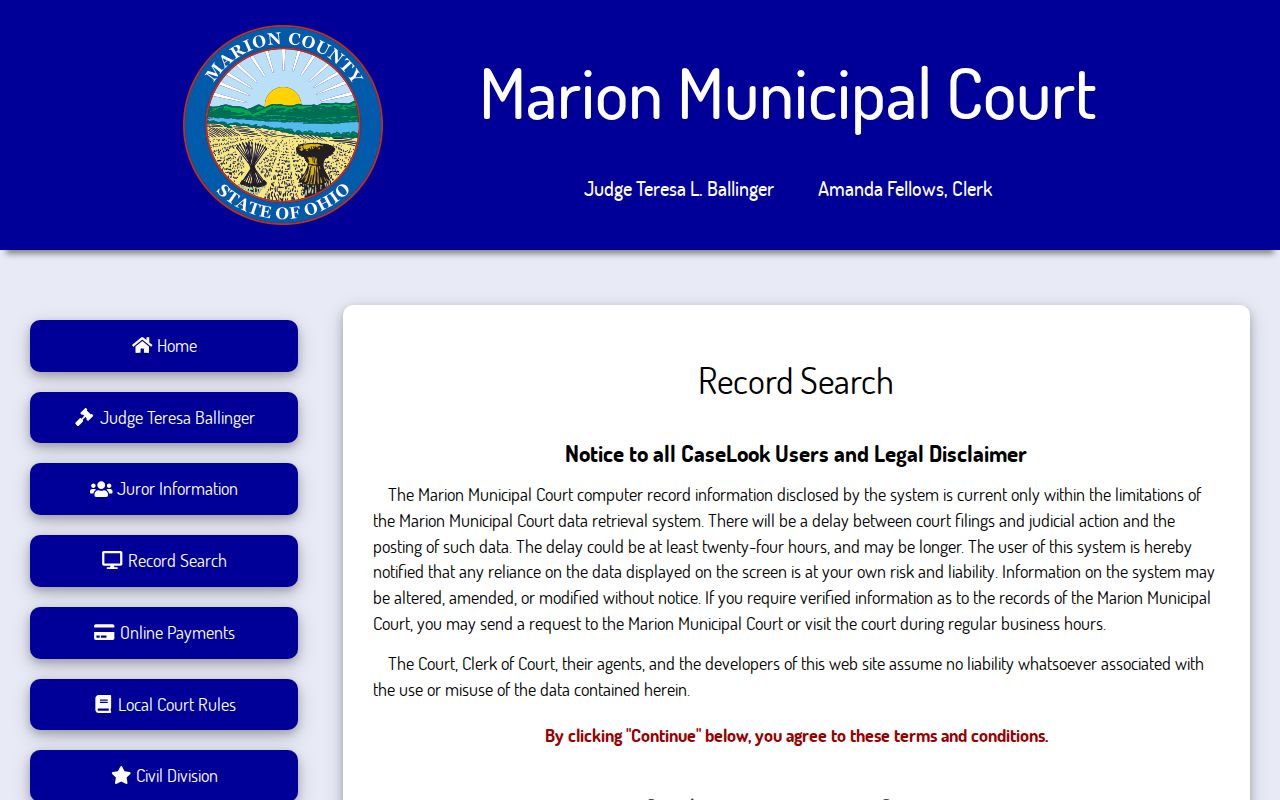
A case number and court division give a search a useful boundary. A party name alone does not establish that a record belongs to the Marion Township resident being verified.
Marion Township Voter Fields
The Marion County voter-tool page links voter lookup, polling-place search, voter reports, street reports, and precinct displays. The name lookup uses Last Name and First Name fields. For larger official reports, the Board provides PDF and CSV options with geographic, party, history, and address-sorting controls. Marion Township precincts are listed as A through F in the street-report tool. These are public election-record tools, not a complete resident list.
Ohio Revised Code 3503.13 excludes telephone and email information, credential numbers, confidential-voter records, protected addresses, and other listed fields from public voter disclosure. A voter result may help distinguish a person when its date and address agree with independent records. It cannot prove every person at a property, because nonvoters, minors, and protected participants may not appear. For historic or broader existing files, a precise request to the Marion BOE is the documented fallback.
Note: A precinct is election geography, while a tax district and a postal label answer different location questions.
Marion Township Vital Confirmation
Marion Public Health supplies the local certified-copy path for Ohio birth and death records. Its Vital Statistics page says the office can issue statewide Ohio birth and death records, holds local birth certificates from 1908 and Marion County deaths from 1954 forward, and prepares counter copies while a visitor waits. The office also offers an online ordering channel with a service fee and expedited shipping. It says ordinary certificate applications and payment are not accepted by mail. The local listed fee is $25 per birth or death copy.
Marriage licensing belongs with the County Family and Probate Division, while estate files are obtained through Probate Court. The library adds historical marriage, birth, and death microfilm, and its directory and obituary materials can supply a date or name variant before a custodian request. Death certificates with a Social Security number require authorized status and proof of identity. For an adoption or birth-parent question, use the Ohio Department of Health's official adoption-file process, not a public-record shortcut.
Same-Name Marion Township Lookup
Same-name errors are the central risk in a resident lookup. The most reliable correction is not more results, but a tighter comparison. Keep a small set of facts that can coexist: an exact name form, a time window, one address or Township field, a parcel or case number, and a record date. Then compare only records that make sense together. A court caption might use a middle initial; a deed can show a person as a grantor; an obituary may use a maiden name. Each may be a clue, not a final identification.
| Result detail | How it helps |
|---|---|
| Parcel and legal description | Links an owner result to one piece of land and reduces postal-label confusion. |
| Court and case number | Lets the proper clerk confirm the right file and division. |
| Recorded date and party role | Separates a buyer, seller, lender, or other indexed party in a deed result. |
| Event date in a vital or obituary lead | Tests whether a family-history result fits the time period. |
The Recorder's AVA index can be useful after an Auditor result supplies a party name, parcel, or legal description. Its County configuration supports party, date, document, book/page, parcel, subdivision, and township searches, but has address search disabled. A broad name query can be limited, so narrow it with dates, parcel, legal-description fields, or document type rather than assuming its first matches are exhaustive.
Resident Lookup Custodian Requests
Insider tip: Ohio's Public Records Act does not require special wording. The Sheriff policy described in the research confirms that an Ohio public-record request may be oral, written, or online, provided it clearly identifies an existing record. Under ORC 149.43, an office must allow prompt inspection at reasonable times, provide copies at cost within a reasonable period, and identify the legal basis for a denial or redaction.
For a Marion Township record, give the custodian the parcel or situs address, the record type, and a narrow date range. A Township request might ask for zoning-permit applications and final actions for an address, or board-minute references to a parcel. A Clerk request should name a case number and document. If the office does not maintain a searchable compilation, the law does not require it to create one. Ask how the records are kept, inspect first if volume is unknown, and request electronic copies when the office keeps them electronically.
Marion Township Lookup Sources Compared
Official records and compiled lookup products answer very different questions. A custodian can explain its own record, its date, and its limits. A compiled product may combine old directory fragments, marketing data, and record extracts with unclear update timing. Treat a compiled result as an unverified lead, never as proof of identity, residency, or a protected address. The record holder remains the place to confirm a document or correct an error.
| Source type | Useful for | Key limit |
|---|---|---|
| County or court custodian | Confirming a named record, document, or case | Coverage and public access vary by record |
| Library or historical repository | Dates, former names, obituary, and directory context | Historical evidence is not proof of a current address |
| Compiled lookup category | Starting a question to verify elsewhere | Identity matching and freshness are uncertain |
For a family-history or heir question, the Library's obituary cards from 1985 through 2009, newspaper microfilm, and probate route can form a principled trail. An old address still needs a current parcel or Recorder check before it is treated as present information.
The official Ohio DRC offender search is a separate custodial-status route, not a general resident lookup.
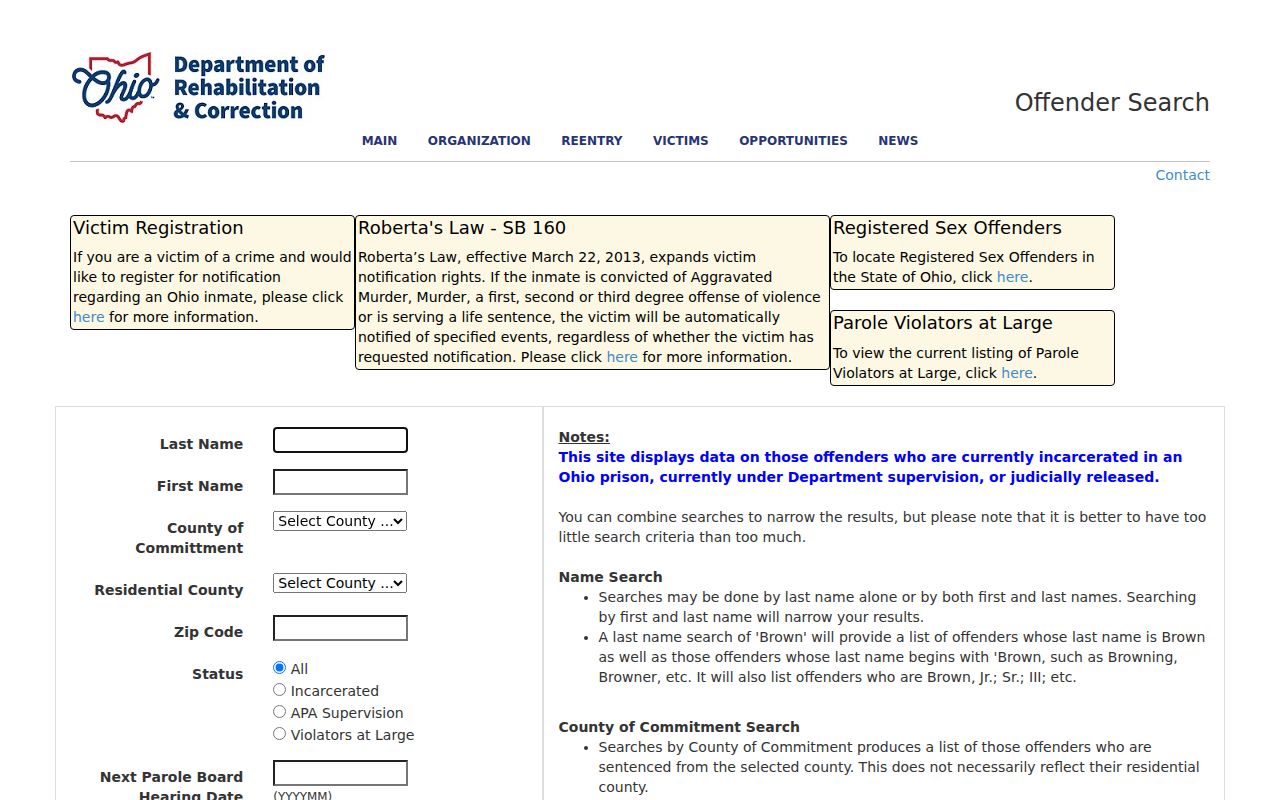
Use a correctional-status record only for its stated purpose, and compare any name hit with the responsible agency before drawing a conclusion about a person.
Marion Township Lookup Boundaries
Some gaps are required by law, not a search failure. Ohio Safe at Home participants can use a substitute address, and ORC 111.44 keeps participating voter information out of public voter records. Court sealing, juvenile and medical-record restrictions, protected victim information, and other exemptions under the Public Records Act also control. Ohio has no verified universal deletion route for public data in the research. A person seeking a permitted record redaction should contact the relevant Recorder or custodian rather than trying to reconstruct information from other sources.
Lawful use. A Marion Township resident lookup is for personal, lawful research. Public records do not permit following, threatening, stalking, or harassing another person, and Ohio law prohibits that conduct.
DMV information, utility-customer data, private household information, sealed records, and protected addresses are not a workaround for a name search. Stop where the public trail ends, or use consensual contact. The Ohio Attorney General's Public Records Act guidance explains request rights and an office's redaction duties.