
Marion Township City Directory Holdings
Marion Public Library's Family Ties guide makes the Local History Room the central shelf for historic Marion research. Its directories and phonebooks run from 1915 through 2022 and are arranged by date and publisher. Polk, Dickman, Robinson, Yellowpages, and other publishers appear in that run. The material is held on paper and microfilm, rather than as a confirmed online name-by-name database. Start with the volume nearest the year of interest, record its publisher and title page, and treat a missing year as a gap unless a staff member locates another copy.
| Collection | Years | Where Held | Access |
|---|---|---|---|
| Directories and phonebooks | 1915–2022 | Marion Public Library Local History Room | Paper and microfilm |
| Farm Journal Illustrated Directory | 1918–1923 edition | FamilySearch catalog and Internet Archive scan | Catalog finding aid and digitized scan |
| Marion Star and local titles | Oct. 8, 1878–Dec. 2019 | Marion Public Library | Microfilm by paper and issue date |
| Obituary Files | 1985–2009 | Marion Public Library Local History Room | Paper cards by surname |
These are overlapping tools, not a single uninterrupted city-directory series. The guide confirms the broad 1915–2022 run but does not document every annual issue or every publisher's geography. A listing can cover the City of Marion, a rural route, a nearby business address, or no Township address at all. The safest citation keeps the printed year, publisher, page, and the wording as it appeared.
Note: A volume's title and stated coverage matter more than a modern postal label when identifying a Marion Township household.
Marion Township City Directory Shelf
The Marion Public Library genealogy collection is also the practical route when a directory result needs context. Along with directories, it lists historical newspapers, obituary resources, family histories, DAR volumes, war rosters, Marion histories, photo collections, and cemetery records. The Local History Room is at 445 E. Church St., Marion, Ohio 43302. Published hours are Monday through Wednesday 9–7, Thursday and Friday 9–5, and Saturday 10–3; it is closed Sunday. Calling first is sensible when a particular microfilm reel or volume is essential.
The catalog is useful before a visit, but access terms apply to some research databases. The Library identifies Ancestry Library Edition as an in-library resource, so current access should be checked with staff. Ask for the requested year and publisher, then ask whether the item is paper, microfilm, or stored elsewhere. That narrow request gives a librarian enough detail to locate the right shelf without turning a local-history question into a vague name search.
The Marion Public Library catalog is the first place to test a known title or publisher before making the trip.
Catalog results help establish whether a likely volume belongs to the local collection, while the physical item remains the source for the printed entry.
1918 Marion County Rural Directory
The 1918 Farm Journal item is a distinct county rural directory, not one more annual city directory. The Internet Archive scan of The Farm Journal Illustrated Directory of Marion County provides an 188-page copy contributed by the Allen County Public Library Genealogy Center. FamilySearch catalogs the 1918 item as a county rural-directory book and microfilm. Its scan warns that pages are missing or out of order, so image-page citation is more reliable than a bare OCR search.
An inspected entry may contain a person's name, spouse or children when printed, occupation, apparent ownership or acreage notation, route or post-office locality, and telephone notation. Those details make it richer than a simple alphabetical listing. They do not make it a Township-only directory, and no remotely verified Marion Township subsection or uniform abbreviation legend was found. Transcribe from the image, preserve uncertainty, and compare the entry against a deed, cemetery, or newspaper source.
A scan from the 1918 Farm Journal rural directory shows the form of this countywide historical source.
Because page order and completeness vary in the scan, the original image should remain beside any transcription or family-tree note.
Reading Marion Township City Directory Entries
Marion's documented directory run lists residents and businesses by address and type of business. Begin with what the particular page actually prints. A usable entry may offer a name, street address, business-type information, publisher, volume year, alphabetical placement, street or reverse placement, and nearby listings. The research does not confirm a standard spouse notation, owner mark, personal-status field, widow abbreviation, or legend across every local volume. Do not fill those blanks from a different city's directory style.
| Printed name | Record spelling exactly, including initials and variants. |
|---|---|
| Street or route | Capture the address or rural notation as printed in that year. |
| Business type | Use only the type of business or activity actually shown in the volume. |
| Publisher and year | Identify the specific directory or phonebook, not merely “Marion directory.” |
| Page setting | Note whether the listing is alphabetical, street-order, or near related names. |
- Criss-cross directory
- A directory section arranged by street and number when a particular volume includes one. It is useful for checking an address, not proof that every year has that section.
- Householder index
- An index organized around a household name. Confirm whether the named volume actually provides it before relying on the label.
- Abbreviation key
- A publisher's legend, often near the front or back of a book. Photograph it only when the volume contains one.
Marion Township City Directory Boundaries
“City directory” describes a collection type. It does not prove that every entry stood inside today's City of Marion. Marion Township surrounds the City, and earlier rural households may appear under a rural route, township description, or Marion delivery label. Others may be absent because the publisher did not cover that area or did not list the household. Keep the volume's title, stated territory, format, and publication year with each result.
That boundary check also keeps modern records in their proper place. A current parcel question belongs with the county's tax-district and Township fields, not with a historic city-directory entry. For a present-day address chain, the Marion Township street directory uses the Auditor, parcel map, and Recorder as the primary records path. Historical volumes are evidence of what was printed at a date, not a substitute for those official property records.
Marion Township Directory Gaps
When directory years skip over a move, Marion Public Library's newspaper material can test the interval. The Marion Star microfilm starts October 8, 1878 and continues through December 2019. Newspaper clipping files cover 1966–2009, while the obituary-card file spans 1985–2009 and is alphabetized by surname. These collections can supply an obituary date, a social notice, a local business reference, or a property clue that helps distinguish a move from a changed name or an omitted listing.
The Library's historic-newspaper research information also points to Chronicling America as a finding tool. It should not be assumed that a given Marion issue is digitized there. Search the local microfilm by newspaper title and issue date when the online result is incomplete, then compare the notice with the closest directory volume and any probate or cemetery evidence.
Note: A surname vanishing from a city directory can signal a move, death, marriage, business change, address change, or an unlisted household.
Tracing Marion Township City Directory Families
Family history works best as a sequence of dated checks. Begin with the first close directory volume, search surname variants, and preserve the exact printed spelling. Move backward and forward through available volumes rather than assuming annual continuity. Each change in street, route, business notation, or nearby listing becomes a question to test with the decennial census, a newspaper, a vital record, or a deed's legal description.
- Choose the directory or phonebook nearest the target year and record the publisher and page.
- Search the surname and likely spelling variants, then note the printed address or rural route.
- Check earlier and later available volumes for moves, name changes, or a different form of the address.
- Pair the dated snapshots with the federal census that is publicly available under the 72-year rule. The 1950 census is public; later schedules are not yet public.
- Use obituary cards, cemetery records, probate material, or newspapers to test the period between volumes.
For a land trail, compare the printed address with the parcel and legal description. A rural route can change, and an older deed may never name the current street. The directory is strongest when its date and wording are preserved beside the independent record that confirms the household or property connection.
Marion Township Local History Desks
The Marion County Historical Society at Heritage Hall supplies a second local research stop. Its searchable database covers more than 34,000 donated and cataloged items, and it offers limited staff research assistance. The Marion Area Genealogy Society is located there as well. Heritage Hall is at 169 E. Church St., and stated museum hours are Wednesday through Sunday, 1–4 p.m., from May through October, plus Saturday and Sunday in November.
The Historical Society can help place an obscure school, church, family, or neighborhood reference around a directory entry. It does not turn private membership material into a public directory. For broader archival gaps, the Ohio History Connection Archives and Library offers research guides, a catalog, appointments, and copy services for land, vital, military, religious, naturalization, and newspaper research.
A view of the Marion County Historical Society collection and research portal illustrates the local institutional companion to the Library shelves.
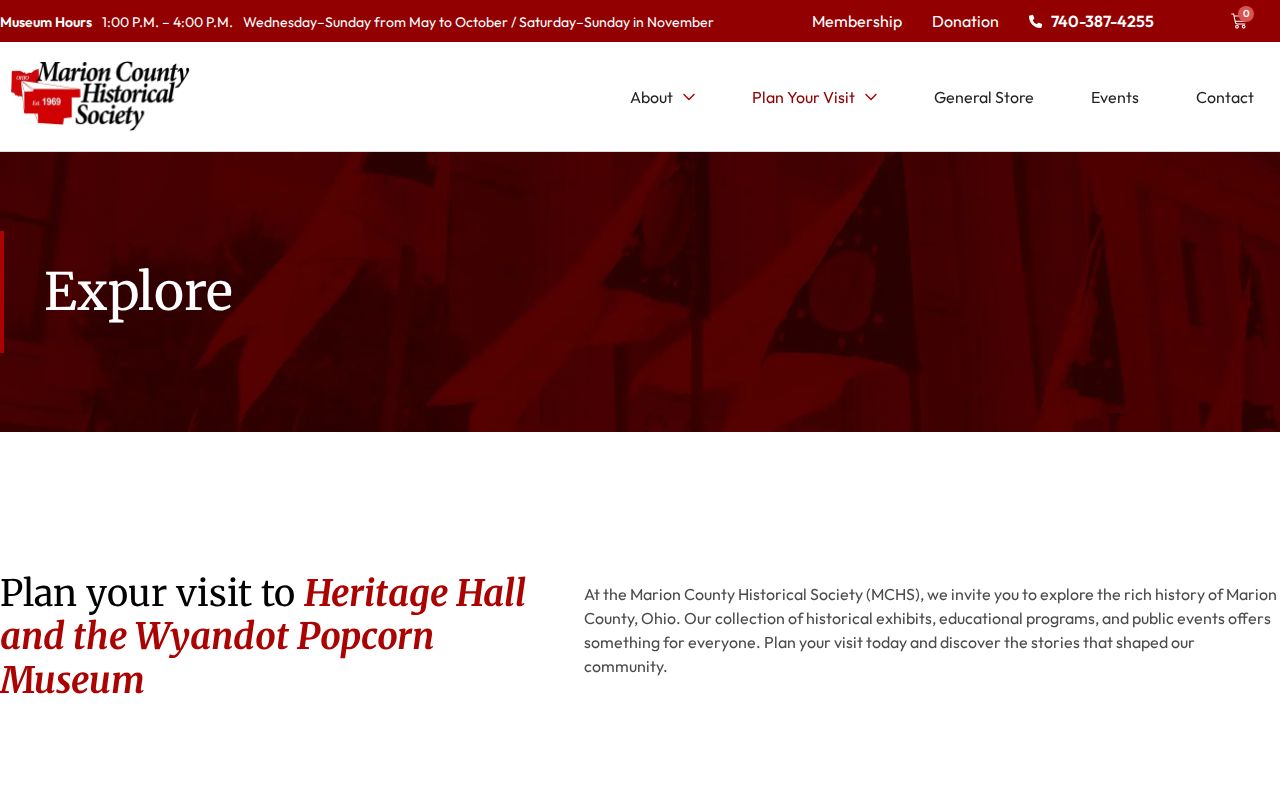
Use a local collection record as supporting context, then cite the printed directory page or original custodian record for the historical assertion itself.