
Finding Marion Township Residents
Marion Township has no single government household roll. The useful trail changes with the question. The Marion County Auditor connects a current owner to a parcel and situs address. The Recorder connects parties to a recorded land transaction. Ohio voter tools can return the public fields permitted for a registered elector, while the Library preserves historical names and addresses. Each record proves a different, time-bound fact. An owner can be a trust or a nonresident, and a voter result does not account for every person at an address.
Start with a name, address, or period of time, then retain the record identifier that comes back. A parcel number and legal description are better bridges than a postal label. For a question about an entire road, use the Marion Township by-street directory after the first parcel is found. For one well-defined person, use the same independent-record approach rather than treating one search hit as a final match.
- Search the Auditor by owner, parcel, or structured address, then confirm that the result falls in Marion Township.
- Note the parcel number, situs address, tax district, owner, and legal description before moving to another system.
- Use the Recorder's party, parcel, book/page, or legal-description fields to locate the related instrument.
- Use the BOE tool only for the fields Ohio makes public, and compare the date and address with the property record.
- For an earlier household, move to the Library's directory, obituary, newspaper, and microfilm collections or make a narrow request to the custodian.
Note: A missing public result can reflect timing, a name-format mismatch, a private record, or a protected address, not proof that a person is absent.
Marion Township Records Offices
County offices hold most modern records tied to a Marion Township address. The Township holds its own minutes, zoning actions, road material, and cemetery-related records, but it does not replace the county property or land-record systems. The three desks below are practical starting points for a parcel, deed, or voter question. Court, Probate, Public Health, and Library records use separate channels when the question turns to a case, an event, or an earlier household.
Marion Township Parcel Search
The Auditor's advanced search is the strongest live starting point for a Marion Township resident search tied to property. It accepts a quick parcel, owner, or address search and also allows structured address parts. Its Township and tax-district filters matter because a Marion mailing label can sit inside the City of Marion or elsewhere in the county. The Auditor reports 35,300 county parcels for 2024, so narrowing a broad owner name with locality details is sensible.
| Auditor field | Use for Marion Township | Format note |
|---|---|---|
| Owner Name | Find a listed owner | Portal specifies Last First |
| House #, Direction, Street Name, Street Type | Find a situs parcel | Each structured part is optional |
| Parcel Number | Return to a known card | Use the map or an existing record |
| Townships / Tax Districts | Separate Township from postal geography | Dropdown location filters |
| Buyer, Seller, and Sale Date | Find a transfer lead | Verify the deed with Recorder |
The parcel card can expose parcel, tax district, land-use and neighborhood codes, address, legal description, owner, sales, improvements, and map-linked tables. Those are property facts, not a complete current-household list.
See the Marion Township official page before using the live tool. Its layout is shown in the image below; the Township filter is the useful local check after an address result appears.
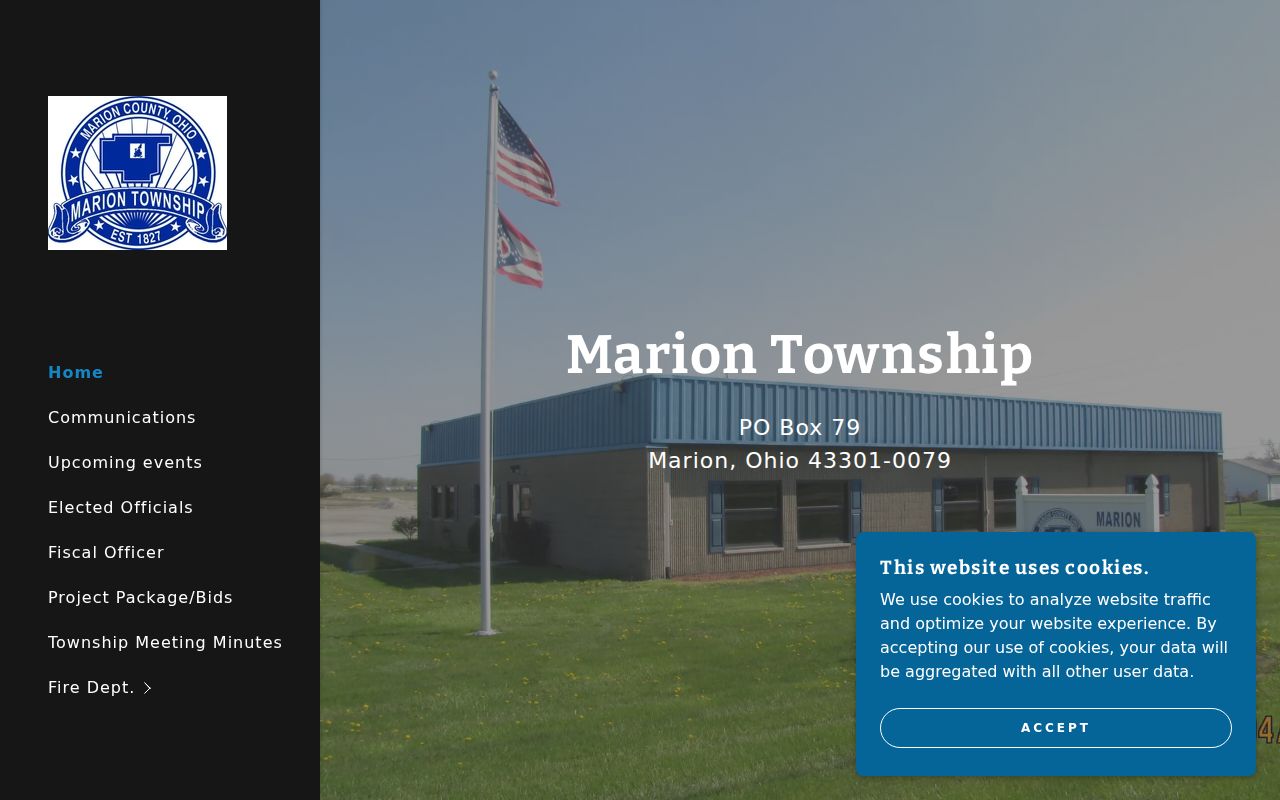
The Township's official presentation reinforces the jurisdiction split: its government records complement, rather than replace, the County property roll.
Marion Township Voter Records
Ohio makes voter registration forms and the statewide database public subject to listed exclusions. For Marion Township, the county BOE links voter lookup, polling-place search, voter-report generation, street reports, absentee tools, and precinct displays. The name form uses last name and first name. A street report can help with election geography, but it is not a roster of every household on the road.
ORC 3503.13 excludes such items as Social Security and driver-license numbers, phone and email details, confidential voter records, protected addresses, and proof of citizenship. The public web output authorized by ORC 3503.153 is likewise limited. A voter result should be treated as one dated signal, then checked against the parcel's Township field and another official record if confirmation is needed.
Current Marion Township Resident Rolls
Use the source that matches the fact in question. An Auditor card is best for the listed owner and parcel. A Recorder result is best for a party to a recorded instrument. The voter tools concern registered electors within Ohio's public-field limits. None has the breadth of a master residents directory, and the gaps are material rather than clerical defects.
| Record source | Fact it can support | Local keeper | Access path |
|---|---|---|---|
| Auditor property roll | Listed owner, parcel, situs and tax details | Marion County Auditor | Free web search, office counter |
| Ohio voter tools | Authorized registered-elector fields | Marion County BOE | Web lookup, reports, office request |
| Recorder AVA index | Recorded-instrument parties and legal description | Marion County Recorder | Free index, counter or written copy request |
| Court and Probate files | Named parties, cases, estates, or marriage records | Clerk and Family/Probate Division | Portal where available, clerk access |
| Library historical holdings | Earlier names, addresses, notices, and family context | Marion Public Library | Local History Room paper and microfilm |
A public record can name an owner without naming all occupants. It can also be old, limited to a transaction, or restricted by law. The most reliable comparison uses two sources that address the same person, location, and time window.
| Official-custodian route | Compiled commercial category |
|---|---|
| Shows the office, record type, access rules, and a way to inspect or request the underlying record. | May combine fragments with unknown timing or match quality; treat it as a lead, not proof. |
Marion Township Recorder Trail
When a parcel provides a listed owner and legal description, the Recorder's AVA index can supply the instrument trail. AVA supports party names, recording dates, document number, type, book/page, subdivision, lot, block, parcel, municipality, and tract-description fields. Its address search is disabled in the local configuration. That limitation makes the parcel and legal description especially important for a Marion Township address.
A document result can include instrument number and type, recorded date and time, book/page, indexed parties and roles, legal description, associated instruments, consideration or fee fields where populated, and image-page count. Image availability and pricing were not established for every record. Use the Recorder's records-search instructions for counter or written copy and certification options.
The official Recorder search is illustrated here.
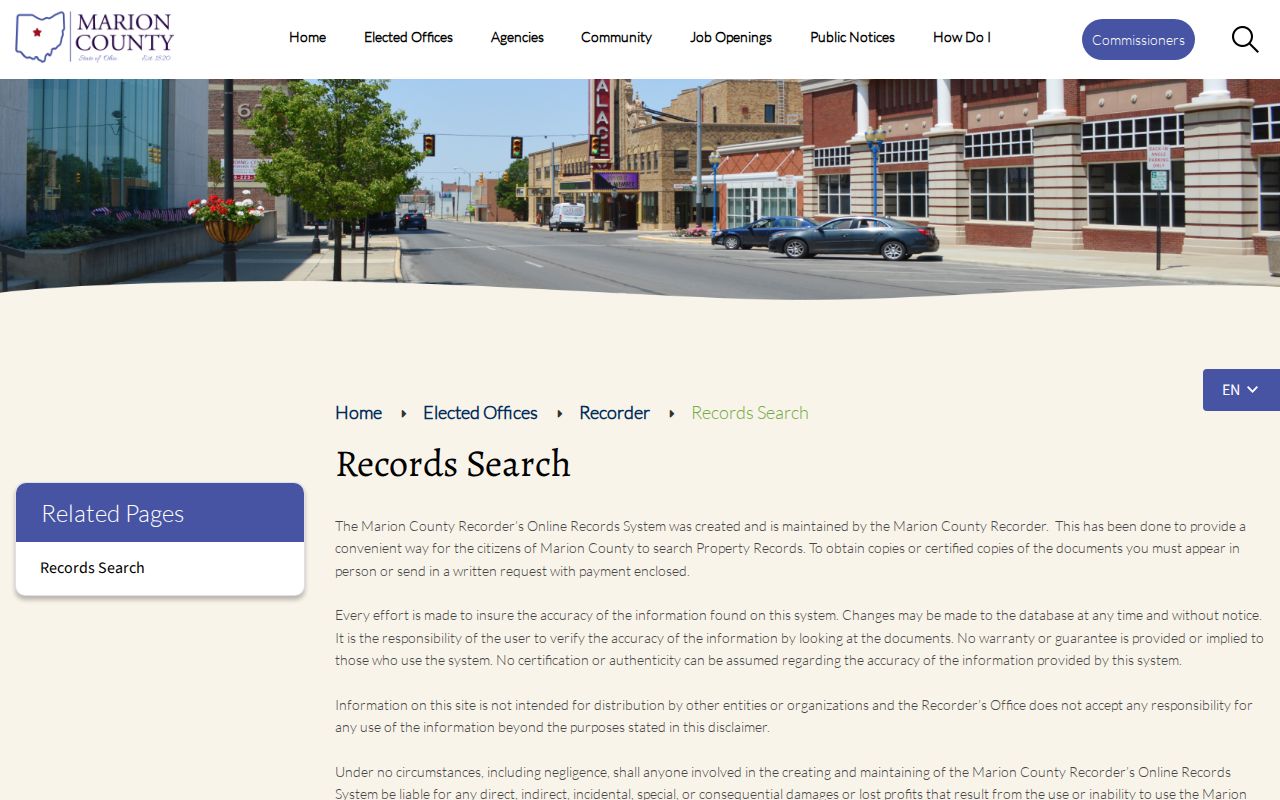
For an older address, record the book/page and legal description beside the street number. A deed establishes a recorded ownership transaction, not every person who lived on the parcel.
Marion Township Court and Vital Records
Courts and vital-record custodians answer narrow questions that a property card cannot. Common Pleas eAccess publishes public information for civil, criminal, Family, and Third District Court of Appeals matters, while certified copies come from a deputy clerk. The Marion Municipal Court warns that CaseLook data can be delayed at least 24 hours and should be verified through the court process. Probate handles estates and marriage functions, with confidential and sealed material outside ordinary access.
Common Pleas eAccess is shown below. A party name must be checked against court, division, case number, and filing date before it is tied to a particular Marion Township resident.
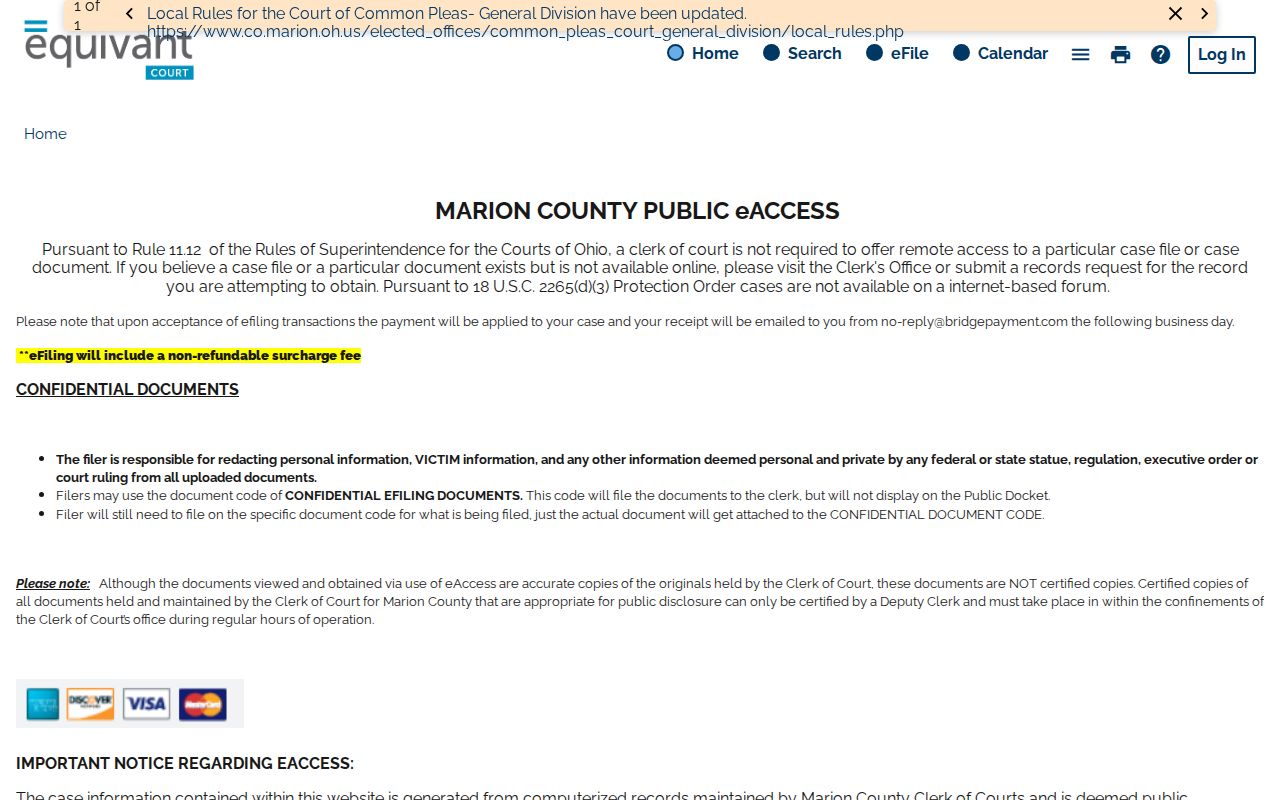
The Clerk's local office is the route for certified material and for web records that were not published online.
Marion Public Health issues many Ohio birth and death copies and keeps local birth records from 1908 and county death records from 1954 forward. It prepares counter copies while the visitor waits and offers online ordering; ordinary certificate purchases are not accepted by mail. An ordinary birth certificate does not require identification when accurate record information is supplied, while a death certificate's Social Security number has a separate authorized-requester rule.
The Marion Public Health certificate page appears below.
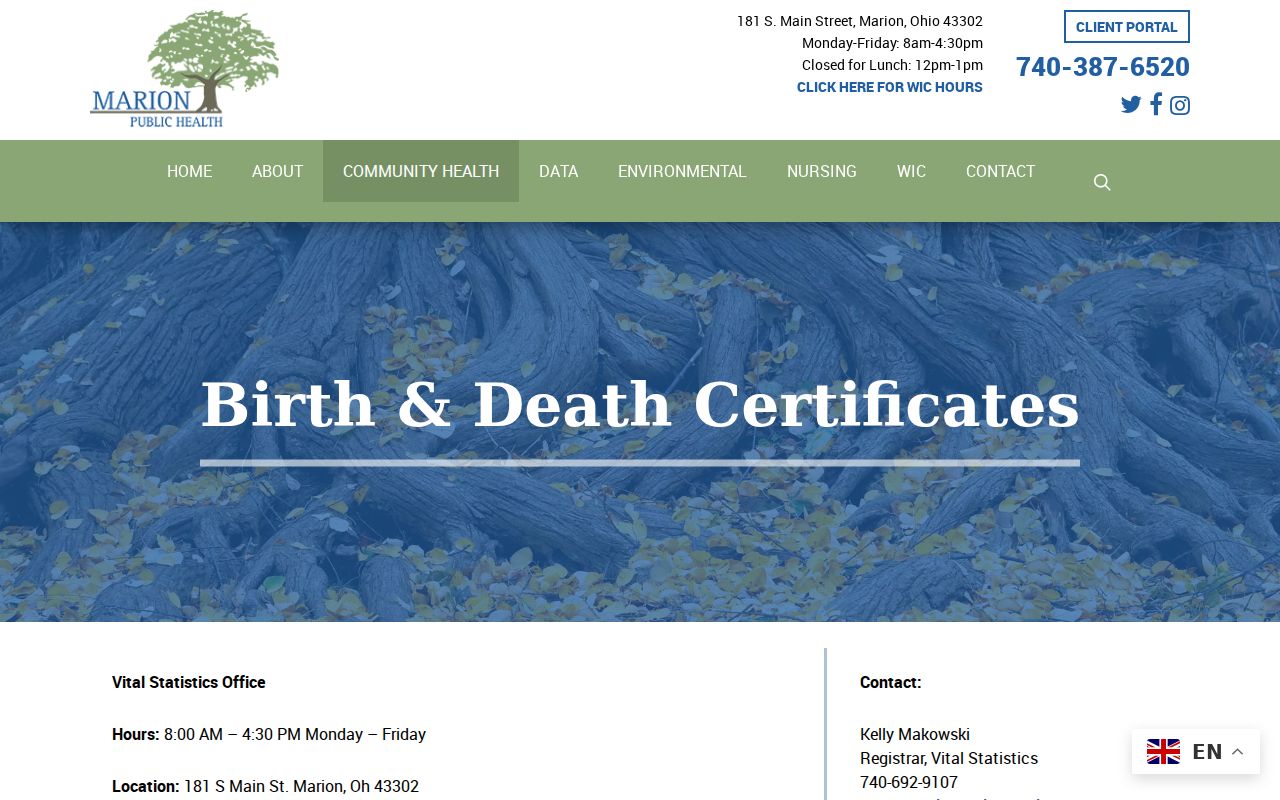
For adoption questions, use the Ohio Department of Health adoption-file process rather than trying to infer a person through local certificate records.
Historical Marion Township Directories
For former residents, Marion Public Library's Local History Room is the local shelf to use. Its Family Ties guide lists directories and phonebooks from 1915 to 2022, organized chronologically and by publishers including Polk, Dickman, Robinson, Yellowpages, and others. The volumes are paper and microfilm, not an asserted complete online name index. Their title, year, publisher, and geographic coverage should be retained with every notation.
The same guide identifies Marion Star microfilm from October 8, 1878 through December 2019, obituary cards from 1985 to 2009, county marriage microfilm from 1824 to 1964, and local yearbooks including Quiver from 1912 to 2017. A directory disappearance can mean a move, death, missed listing, or a changed address. Pair it with a newspaper, census, obituary, or probate record instead of assuming a vacancy.
- Parcel
- A county identifier tying a mapped property to its tax record.
- Index
- A finding tool that points to a record; it is not always the complete record image.
- Criss-cross directory
- An address-organized directory, when a volume includes that arrangement.
- Legal description
- The recorded land identity that can outlast a street-number change.
The full collection details and household-tracing method are on the Marion Township city directories page.
Marion Township Records Since 1820
Marion County was founded in 1820. FamilySearch catalogs abstracts for Deed Books 1 through 4, covering 1821 to 1832, as a physical-library finding aid with grantor, grantee, book/page, dates, and legal-description clues. The Library's marriage microfilm begins in 1824. These early records are book/page and party research, not modern address searching.
The local historical trail has other firm dates: county vital registers cover 1867 through December 19, 1908; certificates follow from December 20, 1908; the local directories start in 1915; and the obituary cards have a defined 1985 to 2009 run. The official sources did not establish an earliest online Recorder year or a countywide imaging cutover. Leave that question to the Recorder rather than guessing.
Marion Township Zoning Records
Township records offer a local address trail after county land records. The Zoning Inspector keeps permit applications and action taken under the Township resolution, but no searchable public permit database was verified. The official zoning page directs users to the Auditor search and provides a Township contact route. A focused request should state the situs address, parcel, record type, and bounded date range.
Recent Township minutes are also a live records source. Trustee minutes posted from August 2025 through July 2026 and zoning-body minutes posted from 2023 through June 2026 show actions, hearings, road work, and permit-ledger categories. They are public government documents, not a substitute for a directory of residents.
The Township elected-officials page is pictured here.
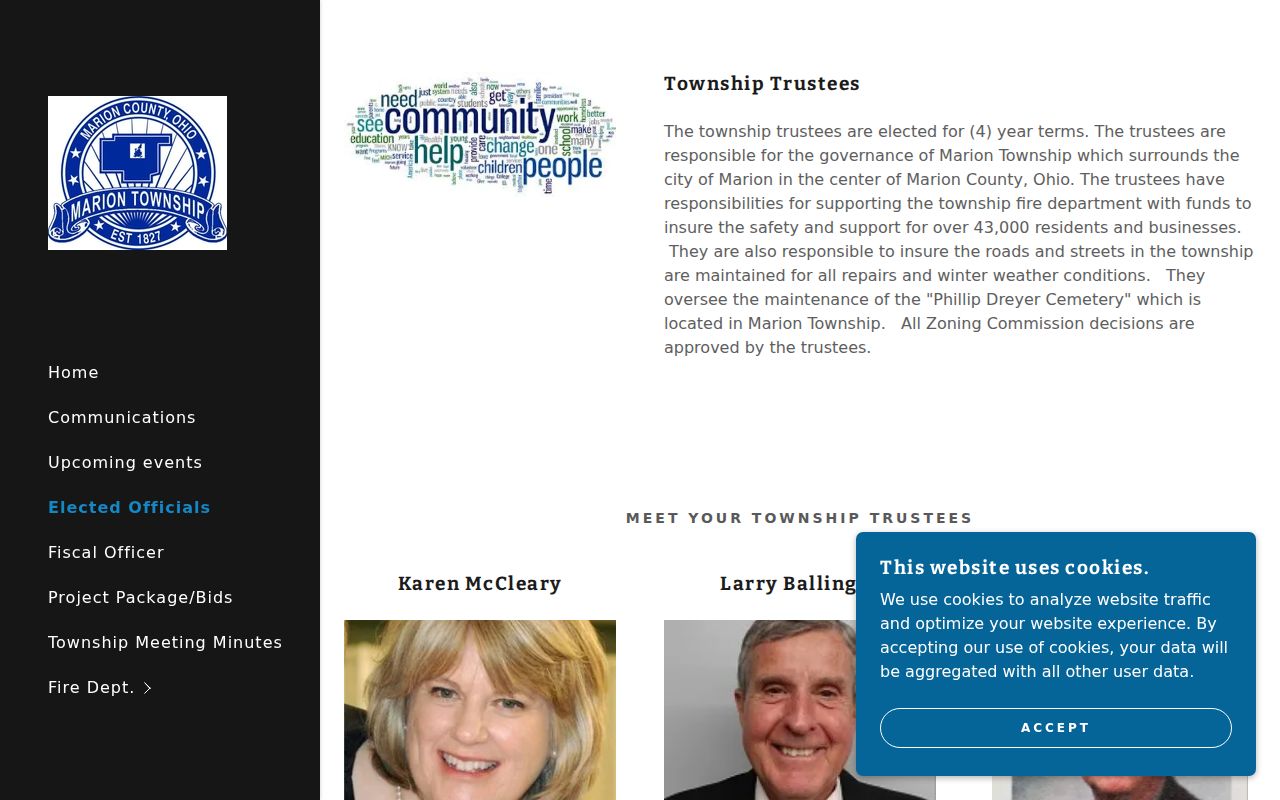
The image helps place the Township in the records chain: it is the custodian for Township-created materials, while County offices control property, deeds, elections, and most court files.
Marion Township Custodian Requests
Ohio's Public Records Act, ORC 149.43, provides the fallback where a record exists but no online index does. Inspection should be prompt during regular business hours. Copies are at cost within a reasonable period, and a requester does not need special language, an identity, or a stated purpose. If an exempt detail must be removed, the custodian should release reasonably separable material and provide the legal basis for a denial or redaction.
Use that route for an existing Township zoning application, action record, cemetery ledger if retained, or board-minute reference to a parcel. Ask first to inspect a broad collection when its volume is unknown. The office need not create a new compilation or reach a conclusion about an unknown person. That distinction keeps a request useful and fair to the records staff.
Note: The Sheriff's 2025 policy also recognizes oral, written, and online record requests and stresses enough clarity to identify the existing record.
Marion Township Safety Checks
Official information can still be used to spot a scam. The Auditor warns about online videos promoting a fictitious federal “Senior Homeowner Tax Review Request” form and says there is no such federal program or form. A deed-copy, tax-relief, or payment notice should be checked with the actual Auditor, Recorder, Treasurer, or court contact rather than a number printed on an unsolicited notice.
The Marion County Sheriff inmate portal is a current-custody interface, not a permanent criminal-history archive or a general directory. Its search and result fields are shown in the image below.
Use a sheriff or offender result only within the scope the custodian states. A name match alone does not establish identity, current residence, or a reason to contact anyone.
Marion Township Credential Checks
When two people share a name, Ohio eLicense can corroborate a public professional credential after the person is otherwise identified. The statewide tool covers 24 boards and agencies and says its data is updated daily. Its help material recommends a last name plus first initial, or a complete license number, followed by a board selection. A credential can distinguish a person or verify public status, but it does not establish a home address.
The Ohio eLicense verification tool is shown below.
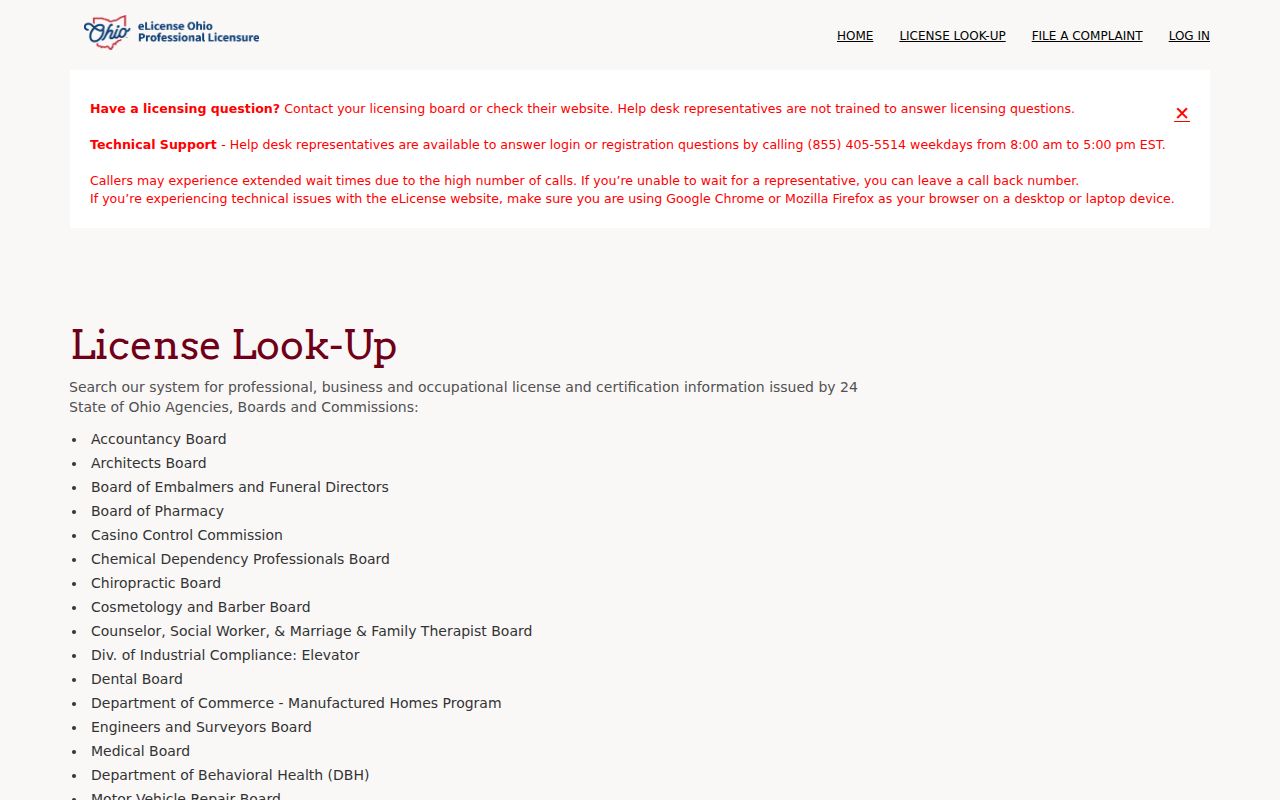
A public license detail can show status, board, type, number, and dates. Compare those facts with the correct name and time period, then return to the actual custodian for a question about a record.